
Authors: Philipp Bühler & Dominik Habermacher
Why today decides who gets booked tomorrow
Anyone planning a trip makes not just one, but many decisions: destination, hotel, activities, travel. One question leads to the next; the undertaking is complex and information-heavy. That's precisely why the use of AI in travel planning has become the norm for more and more users. And that's precisely why Generative Engine Optimization (GEO), i.e., the preparation of content so that it can be understood, referenced, and cited by AI chatbots (like ChatGPT or Gemini) and AI search engines (like Perplexity), is more relevant than ever in tourism.
The Numbers: Artificial Intelligence in Travel Planning
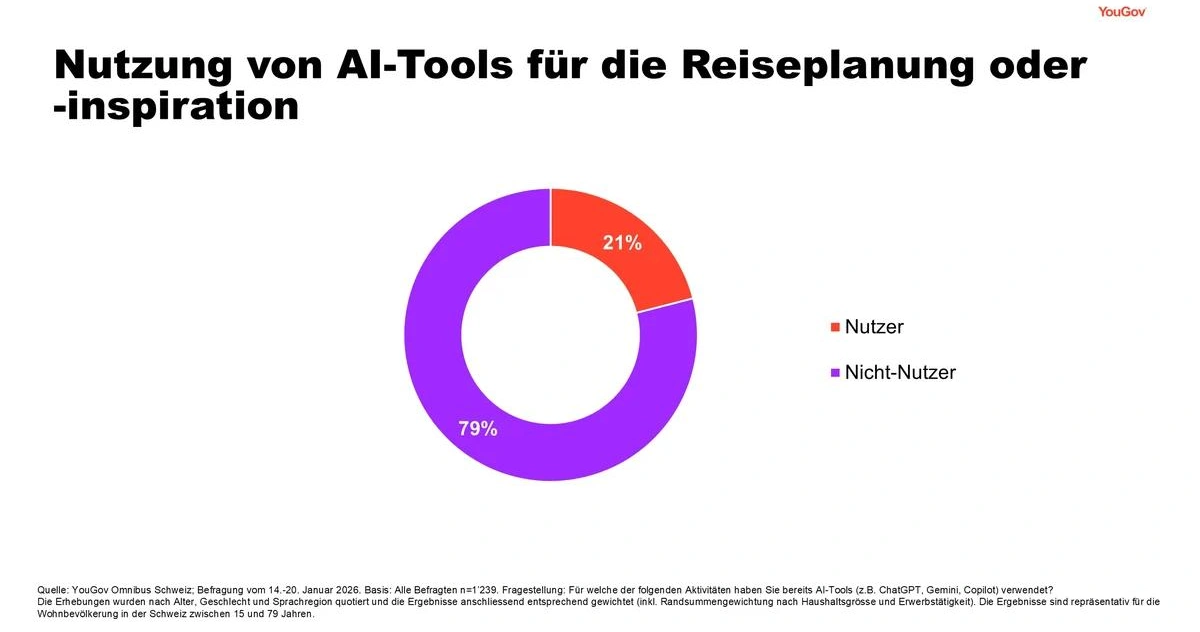
A representative study by YouGov Switzerland from January 2026 shows how quickly user behavior is changing. According to the study, one-fifth of the Swiss population already uses ChatGPT, Gemini, or Copilot for travel planning. Among those under 45, it's almost a third. ChatGPT clearly dominates with an 88 percent market share among AI applications.
It's interesting to see what AI is used for in travel planning: 66 percent use it to suggest activities, 45 percent for destinations, 43 percent for travel routes. Precisely the phases where guidebooks, blogs, and tourism organizations used to be the central sources of information. The inspiration and orientation phase is shifting to LLMs.
The growth potential is significant. 71 percent of current users want to use AI more frequently in the future. And 20 percent of previous non-users want to at least try it. Therefore, it applies: Anyone who doesn't appear in an LLM's answer today will miss out on a significantly larger audience tomorrow.
What we observe with our Swiss travel customers
We support various travel brands in GEO and performance marketing, such as Switzerland Tourism, CERVO Mountain Resort, Camping Lodge, and The Tschuggen Collection.
Switzerland Tourism: Advertising in LLMs, not for its own website
The task for Switzerland Tourism is not primarily to drive traffic to its own site. Rather, it is about positioning Switzerland as a destination in LLMs. So, marketing for a country. This also changes GEO's approach. One has to think more outside the box than with classic SEO. GEO does not only concern one's own website. Comparative information ("Is Austria or Switzerland better for skiing?") is not offered by Switzerland Tourism, but on overarching tourism portals. These portals should be included in the GEO measures.
CERVO: From Visibility Gap to Concrete Measure
CERVO faced the challenge that although the hotel offers outdoor activities, it did not appear in the top 5 in relevant LLM responses for outdoor hotels in Zermatt. Such responses come from comparison portals, travel blogs, and editorial lists. One cannot objectively evaluate competitors on one's own hotel page. That is the function of third-party sites. Whoever is missing there is missing from the answer of ChatGPT and Co.
In principle, this is like SEO backlink building, only more targeted. Today, in monitoring, we see directly which pages appear in the LLM responses and which are missing. This makes the selection of sources where one wants to be mentioned more precise. It's not about link mass, but about concrete mention in the right place.
«The collaboration with Jung von Matt helps us understand AI Search not as a short-term trend, but as a strategic component of our digital visibility. For CERVO, it's not just about being found, but about appearing at the right depth and in the right context. As a Mountain Resort that combines nature, design, culinary arts, movement, and consciousness into a contemporary form of hospitality. Particularly valuable for us is the combination of monitoring, content logic, and Digital PR, meaning precisely targeting where travelers today seek inspiration, comparison, and orientation.»
Marcella Corti, Head of Brand, Marketing & Sales, CERVO
What changes compared to classic SEO
SEO remains the basis
Good SEO is a prerequisite for good GEO. Indexability, a clean technical structure, fast loading times, and content depth are basic requirements that apply equally to Google and LLMs. If a bot cannot access a page, it cannot extract any information. In addition, a significant portion of traffic still comes from classic search engines.
The click disappears, the brand must remain
Previously, a good ranking was enough to generate clicks and direct visitors to one's own page. If the click, however, fails to materialize, because users get the answer directly in ChatGPT or Perplexity, then the brand must be recognizable in the answer. Brand name, product designation, differentiation. Otherwise, the user might still Google, but they won't Google the brand because they no longer remember it due to the answer.
Verbal Identity in the AI Answer
An LLM does not quote, it paraphrases. Everything interchangeable disappears in the process. What remains are unique terms and genuine differentiation. Whoever lacks both appears nameless in the answer.
More on Verbal Identity from Jung von Matt: jvm.ch/de/verbal-identity-audit
The trick tactics work, but not for long
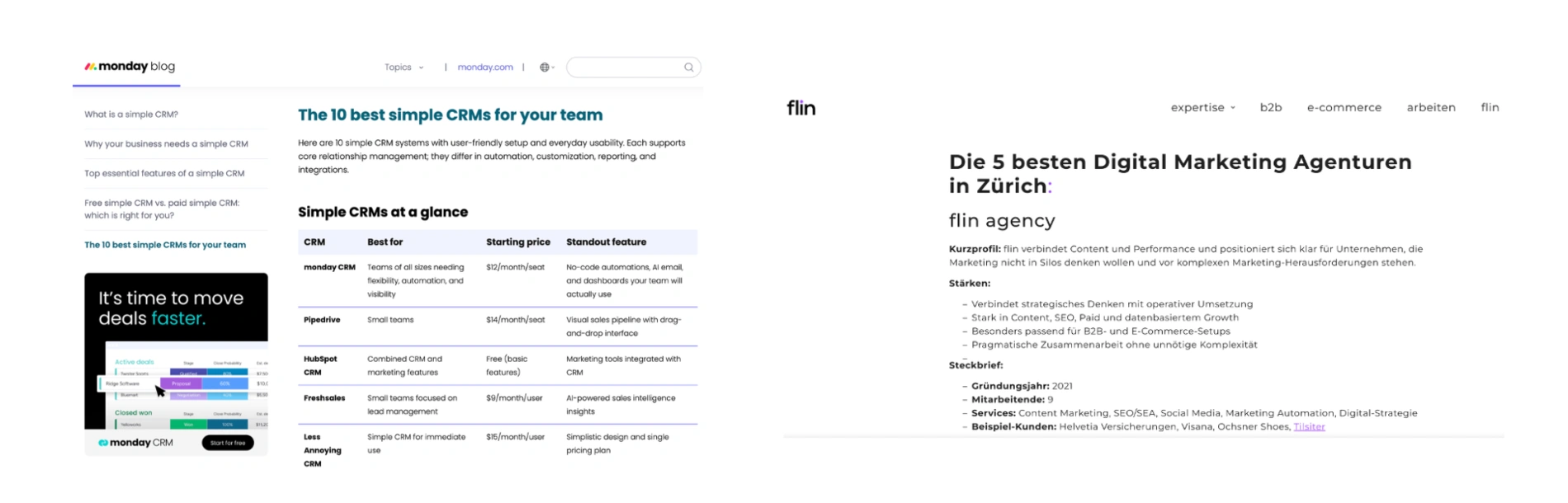
We see many SaaS companies and SEO agencies creating top lists and placing themselves at number 1: What are the top 5 CMS, what is the best SEO agency? Own answer, own position. This currently works. But that's the white text on a white background from 2010. It works until it no longer works. And users don't trust self-assessments anyway.
What we specifically recommend to brands for GEO
Three levels that must work together.
Monitoring on three levels
The first level is Web Analytics. Direct Referrals, references from ChatGPT, Perplexity and Co. Google Analytics 4 is the obvious solution. Google has announced native support for AI channels. We already see this in some properties, but not yet in others. We have been reporting traffic via AI Search in the dashboard and in custom reports for our clients for a year.
The second level is the server log files. Server-side, preferably automated. Here you can see which bots access the site and for what purpose. There are bots that crawl content for training. Other bots access websites live at the moment of a user request. Both are treated differently and have different significance. For example, with a client who has a large B2B online shop, we saw a ratio of 1 to 10: For every measurable LLM click in Analytics, there were about ten bot accesses in the server logs. These are 10 potential mentions of the website that do not lead to a click and are therefore not recorded in Analytics ("Zero Click Searches"). This visibility does not appear in any standard report.
In the log files, it is particularly worth looking at status code 499. This means that the client aborted the connection because the server was too slow. This is exactly what is critical for AI Search. Most AI search systems, with the exception of Google and Bing, retrieve pages in real time when a user asks a question. If the page does not respond quickly enough, it is simply omitted from the answer. The brand does not exist at that moment. A high proportion of 499s in the logs compared to AI bots is therefore not a technical detail, but a direct loss of visibility.
The third level is Prompt Monitoring. We track using tools like Peec.ai how a brand appears in real LLM answers, in which positions, compared to which competitors, in which markets. A search from Switzerland looks different from one from the USA. Over time, this provides a comparative value.
«The GEO dashboard developed by Jung von Matt for us is an important first step to better understand the changing search behavior of our guests. At the same time, it forms a valuable basis for the targeted content development and optimization of our websites.» Pascal Urscheler, Chief Commercial Officer, Camping Lodge Switzerland AG
Defining the right prompts
Here lies the biggest methodological challenge. In SEO, we have keywords with search volume. We know whether a term is searched for at all. In GEO, this volume signal is missing. The variation of possible prompts is many times greater than the variation of used keywords. We can track a lot, but the risk is that we observe prompts that no one actually asks.
Our approach: We take keyword research from SEO as a basis and derive plausible prompts from it. If a customer has a chatbot on their own site, this is an extremely valuable data source: Here you can find real user questions. This data can be used as a basis for a representative prompt set. This goes far beyond what classic keyword tools provide.
Closing content gaps, on both sides
If it is clear in which prompts one's own brand is missing, then there are two starting points.
The first is on one's own website. From the prompts and real user questions, topics can be derived for which one's own content is missing. This is classic content work, but with a new data basis. Not the estimated search volume decides, but what the users actually ask. From this, answer pages, FAQ sections, and topic hubs can be created that relate precisely to these questions.
The second starting point is Digital PR. Travel media are suitable for hotel recommendations, comparison portals for comparative queries, and editorial lists for destination topics. No longer is the backlink alone decisive, but the mention of the brand. What is new is measurability. Today we know exactly which source is cited in which answer to which prompt. This makes PR more measurable than it was in classic SEO.
What Google says and what of it is true
Google published an official guide to optimizing for generative AI features in May 2026. The core message: SEO remains the basis, and best practices do not fundamentally change just because Google's AI features are built on existing ranking systems. Google advises against investing in supposed GEO hacks such as LLMs.txt files, excessive chunking, or creating fake mentions. This is correct and important for optimizing for Google itself. But it's only half the story. Google is an important player in the GEO field, but not the only one. ChatGPT, Claude, Perplexity, and Copilot each have their own logic, their own source preferences, their own crawlers. Anyone who optimizes exclusively for Google's statements optimizes only for Google. Anyone who wants to appear in all relevant LLMs also needs monitoring that makes these differences visible. Exactly these differences can only be seen in tracking across multiple models.
What this means for Swiss travel brands
Travel is the area where the shift becomes visible most quickly. Travelers research conversationally, compare across multiple providers, and jump between destination, hotel, and activity. Brands that do not appear in these answers are out of the decision before the booking mask even opens.
Anyone starting with monitoring today will have reliable data within a few weeks: Visibility of one's own brand in LLMs, bot accesses and 499s in the logs, comparison with competitors, distribution across channels and markets. Prompt monitoring already provides the answer today, parallel to classic tracking values. Anyone who sets this up now has two advantages at once. Earlier data points than the competition, and a clear view of where content work on one's own site and Digital PR need to start.
Outlook: Ads in ChatGPT
The next wave is already at the door. ChatGPT Ads are already available in various markets (USA, Canada, Australia, New Zealand, United Kingdom, Mexico, Brazil, Japan, and South Korea) (Testing Ads in ChatGPT). This shifts not only organic visibility but also the paid funnel into LLMs. For our clients, we are currently setting up these new ad formats and closely observing how their performance compares to Google Ads and other paid channels. Those who test early will have the comparative value that will support next year's budget decision.